
AI often does not enter the newsroom through a formal rollout. It enters through convenience.
A reporter uses a chatbot to tighten a headline before publishing. A producer generates a quick translation. An editor summarizes a briefing to save time before a meeting. Each action solves a small production problem, so adoption happens naturally inside existing workflows.
Then the volume increases.
AI moves into more editorial steps and more teams. At that stage, the question is no longer whether AI belongs in the newsroom. The challenge becomes understanding where automation should operate, how much control different workflows require, and how editorial accountability remains visible as AI usage expands.
Many news organizations are now working through that transition. Some experiment cautiously. Others already build operational models around AI-supported production. The organizations seeing the strongest results usually share one characteristic: they treat AI as a workflow design problem rather than a standalone feature.
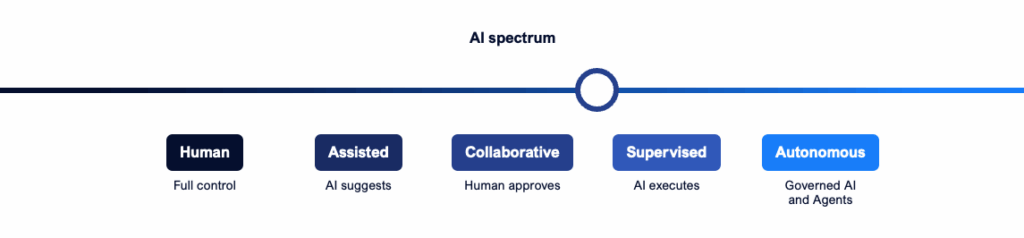
AI works across a spectrum
Editorial production contains very different kinds of work. A morning update, a push notification, an investigative feature, and a print layout all operate under different constraints. Some workflows prioritize speed. Others depend heavily on editorial judgment, nuance, or verification. That variation matters when introducing AI into production environments.
A spectrum model provides a more useful way to think about adoption.
At one end, AI supports journalists and editors directly inside the workflow. Teams use prompts and suggestions for drafting, rewriting, translation, summarization, tagging, or adaptation while editorial decisions remain fully controlled by humans.
Further along the spectrum, AI operates inside structured sequences of configured actions. Repetitive tasks such as metadata generation, content adaptation, or multichannel formatting move through predictable operational paths with clear oversight and consistency.
Viewing AI through the lens of workflows also changes how organizations evaluate the value and monetization of AI. High-volume production areas often benefit from greater automation because operational scale affects both speed and cost. Other workflows depend more heavily on editorial voice, interpretation, or credibility. Different workflows therefore require different forms of automation, governance, and oversight.
What this means for Cue
This spectrum model also shapes how Cue evolves with your adoption of AI. Rather than treating AI as a separate toolset, Cue Autopilot integrates AI capabilities directly into editorial workflows – from assisted drafting and summarization to pre-configured multi-step actions across channels and formats.
The broader direction focuses on full scale orchestration. That includes connecting actions, governance, and decisions into a unified operational layer. It also creates the foundation for supervised agentic workflows that carry out bounded multi-step tasks with defined checkpoints and escalation handling.
For organizations working through AI adoption today, one practical exercise often creates immediate clarity: map a small number of editorial workflows and decide where each belongs on the spectrum.
Some workflows benefit from speed and automation. Others require stronger editorial involvement. Clear operational boundaries help organizations scale the benefits of AI usage while maintaining visibility, accountability, and editorial confidence across production.
The organizations that scale AI successfully are unlikely to be the ones that automate the most. They will be the ones that understand which workflows require speed, which require judgment, and how to design operational boundaries on the entire spectrum.