
MEDIAHUIS ON THE CUE MEDIA ENTERPRISE PLATFORM
The numbers behind the newsroom
30 million
page views a day
2,500
journalists a day across everybrand that has migrated to the Cue media enterprise platform
20+
brands brought together on one platform
1.8 million
subscribers across Mediahuis
5
countries
On the day De Telegraaf went live on the Cue media enterprise platform, the Dutch government fell.
De Telegraaf is the largest title Mediahuis owns. The traffic arrived all at once, on a platform that had been live for a matter of hours.
“We immediately had a huge spike, a huge stress test, and we managed to survive it,” says Peter Soetens, CEO Technology at Mediahuis.
He describes it now as an excellent job by everyone involved. It was a stressful day to find out if our preparation would deliver.
It did.
Seven, seven, seven
The Mediahuis programme behind that launch is called Prisma, and it started in a much less dramatic room.
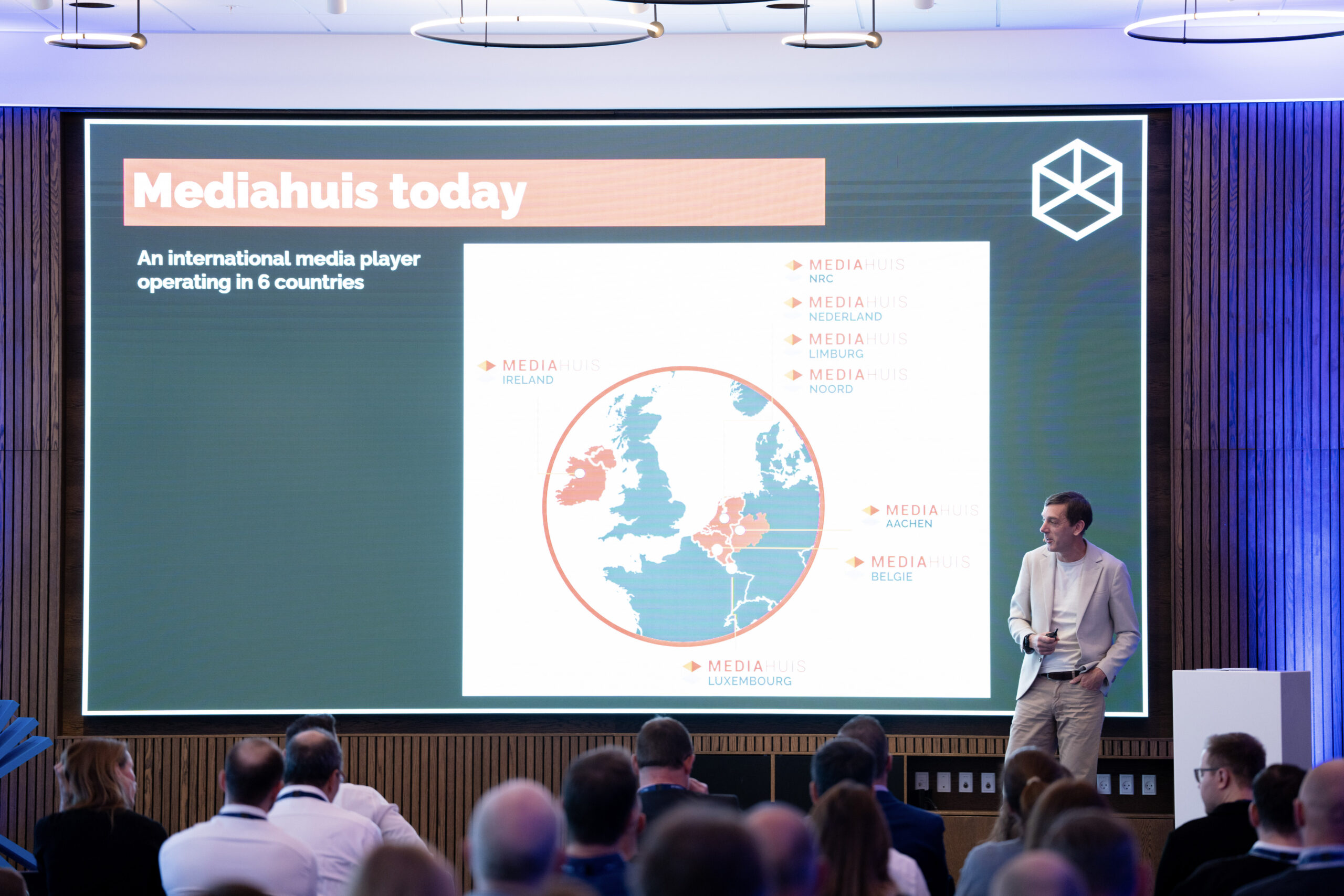
Mediahuis was formed in 2013 from a merger of two Belgian publishers, then grew fast by acquisitions in the Netherlands, Germany, Luxembourg and Ireland. Today, it runs more than thirty news brands across newspapers, magazines, radio and digital marketplaces, with a daily reach of around 10 million people, 4500+ employees and 1.8 million subscribers. Growth through acquisition works until the operational picture underneath it becomes the problem.
So, in 2022, the leadership team looked seven years out and wrote a strategy.
“7-7-7. Let’s move from seventy
percent print-based to seventy
percent digital-based in seven years’ time,”
Peter Soetens
CEO Technology, Mediahuis
The arithmetic behind it was unforgiving and familiar to any news media organization. Print subscriptions are down. Single copy sales are down. Print advertising is down. So, news media organizations must increase print prices, find print efficiencies, grow digital subscription volume and grow digital advertising. The last of those, Soetens notes, is the hardest one for everybody.
Add rising costs and inflation on top, and a gap opened between where the company would land and where it needed to be to hold its 2022 profitability in 2030. Inside Mediahuis, it is simply called the gap.
Closing it meant growing digital faster than they already were and finding operational efficiency they did not yet have.
Six teams, one feature
The efficiency problem had a specific shape.
Because Mediahuis had acquired media operations across Europe, it had inherited the technology of everyone it bought. At the time, six or seven development teams in different countries were building nearly the same features, for different brands, in different markets.
Worse was what that meant for the future.
“The cost of building a platform, that’s not the difficult part,” says Soetens, who has been at Mediahuis for more than fifteen years and in media for more than twenty-five.
“The cost of maintaining a platform
and being able to innovate on top
of it, that’s the biggest challenge
down the road.”
Peter Soetens
CEO Technology, Mediahuis
Running more than twenty brands on separate foundations means that every new capability must be rolled out ten or fifteen times. A new feature that takes weeks to build can take years to arrive.
That calculation produced the program’s founding constraint: one code base, one shared backend, one article model, one design system. Everybody moves to the latest version at the same time, so one improvement lands everywhere at once.
Building blocks
The obvious objection inside a media group of more than thirty news brands is that a single platform flattens them. A regional title, a quality magazine and a popular news brand are not the same product, and their audiences do not want them to be.
Mediahuis answered it with what Soetens calls the “Lego principle.”
The idea is that the deeper layers of the stack are heavily standardized, and the degrees of freedom increase as you get closer to the user. Same technology, same APIs, same design system, different experiences assembled on top. Build a podcast experience close to one brand, hold it to the shared standards, and it becomes available to all of them.
“Differentiate where it makes
a difference and standardize
everywhere else.”
Peter Soetens
CEO Technology, Mediahuis
The apps and sites Mediahuis built on top of are deliberately brand-agnostic. The Cue media enterprise platform sits at the core of editorial, with roughly thirty other systems brought into the newsrooms alongside it: data layers, subscription platforms, commerce. Digital writing and storytelling came first by design. Print systems were left in place at the outset and are being consolidated onto Cue Print now, rather than being allowed to slow the digital work down.
Mediahuis wanted to own its own front end, with apps and sites built on its own design system. Stibo DX built the integration layer that made it work, so the Cue media enterprise platform runs as the editorial core behind an experience Mediahuis controls, and 2,500 journalists a day work in it across every brand that has migrated.
Starting in Luxembourg
The other decision that shaped the Prisma programme was where to start.
The tempting choice is the biggest newsroom, because it gets you the most complete platform the fastest. Mediahuis went the other way and launched first in Luxembourg, one of its smallest titles, while involving colleagues from Belgium and the Netherlands in the design.
“You risk building too much,” Soetens says of starting big. A small, essential system that can actually be maintained beats a complete one that cannot. Features were then added at each rollout, once a newsroom had proved it needed them. Luxembourg went live, then Aachen, then the Mediahuis regionals, then De Telegraaf, roughly a wave every six months.
Then the ground moved
None of this was designed for the global shift that has since arrived.
“When we started this project, we were thinking about the digital transformation we had to tackle,” says Soetens. “We were not even thinking about AI and the creator economy.”
He describes what happened next as a big squeeze. On one side, AI is becoming the new interface: reusing publishers’ content, and positioning itself as the layer between an audience and everything it reads. On the other side, there is a shift in who young audiences trust.
“For years we were the gatekeepers. We were the trusted authority.”
Younger audiences, he argues, increasingly get their news from individuals on creator platforms rather than from institutions. Advertising money follows the trust.
Which is where the platform became a lot more than an efficiency project.
In the second half of 2025, Mediahuis launched a puzzle platform, vertical video, AI-generated video, audio stories, and what it calls Bundle of the Future, a translation of the newspaper reading experience into a digital one. In the quarter that followed came an AI search, a follow-up question feature on articles called Newstrail, and text to podcast.
The business model moved too. A Plus subscription gives a reader who subscribes to one Belgian brand access to all of them, which adds value and improves retention. And an internal newsletter circulates reusable service journalism across countries, translated into English, for newsrooms to pick from. Those reused articles are helping sell subscriptions.
Every one of those launches reaches every brand on the platform, at once, because there is only one platform.
“We don’t know what the future brings,” says Soetens. “But we do know that we need to be able to learn quickly, adapt to what is happening out there, and scale fast across our group.”
From programme to platform
Moving that quickly puts demands on what sits underneath, and Soetens has been clear about what he wants next: for the Cue media enterprise platform to mature as a SaaS platform.
That work now has an agreement behind it. Mediahuis and Stibo DX have expanded their partnership to establish the Cue media enterprise platform as a unified foundation across the group’s brands, countries and channels, covering editorial planning, collaboration, content creation, asset management and multichannel delivery. The architecture is built so those capabilities sit together on one platform rather than being maintained brand by brand.
It is the logic that Mediahuis has followed since their 777 strategy. First, they put more than twenty brands on one platform and now, the new agreement puts that platform on a managed footing, so running it and keeping it current stops being work Mediahuis has to carry alone.
A platform built on partnership
Soetens is clear about what he is proudest of, and it is not just the architecture.
“We are able to launch new
features across the group
at a fast pace…and that’s
something I’m very proud of.”
Peter Soetens
CEO Technology, Mediahuis
He credits the way the work was done as much as the thing that was built. Mediahuis’ Prisma programme was delivered by a project team of around fifty people, drawn from technology and from the newsrooms, working alongside colleagues who knew the titles well.
“It was always in close collaboration with our newsrooms,” he says, “and that’s a big part of the success.”
He ends where the work started: the Mediahuis team who built Prisma, and the colleagues at Stibo DX who built it alongside them. There are challenges ahead, and both companies are ready to face them. On the thing that mattered most, though, his verdict is clear.
“It felt all the way as a partnership,” he says. “…I’m happy where we are today.”