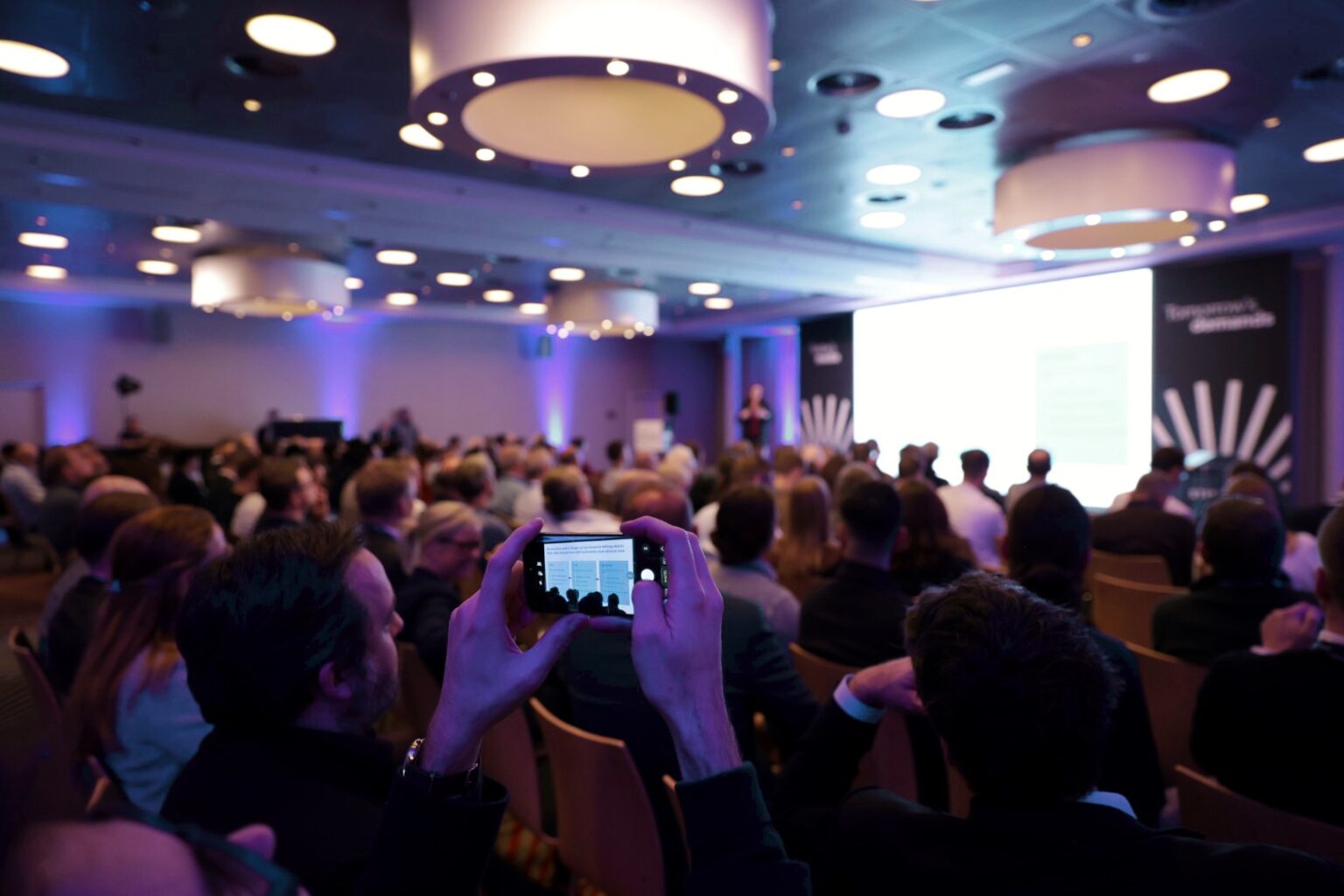

Across customer stories, industry perspectives and product discussions, a broader theme emerged: transforming the newsroom is about much more than introducing new technologies. It requires rethinking how stories are planned and produced, how a modular, fully integrated platform connects workflows, where AI creates value, and where people can make the biggest difference.
Here are 10 key takeaways from Cue Days 2026:
1. Reimagined journalism requires a radically reimagined newsroom
The ways audiences find journalism are changing fast.
Lisa MacLeod, Global Media Analyst, described a fragmented front door to news, where audiences increasingly encounter journalism through social feeds, creators, group chats and AI answer engines.
She cited the Reuters Institute’s Digital News Report 2026, which found that 52 percent of 18- to 24-year-olds now mainly get news via social, video or AI chatbots [1]. As audience expectations shift and journalism moves from articles to fluid multimodal stories across more formats and channels, newsroom workflows are becoming more complex.
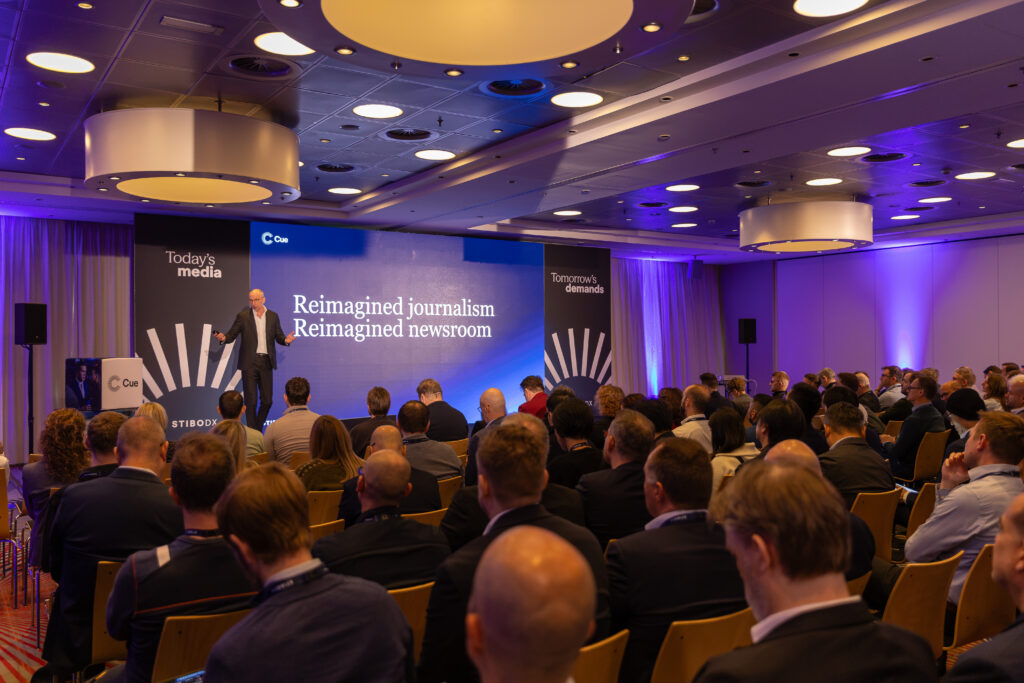
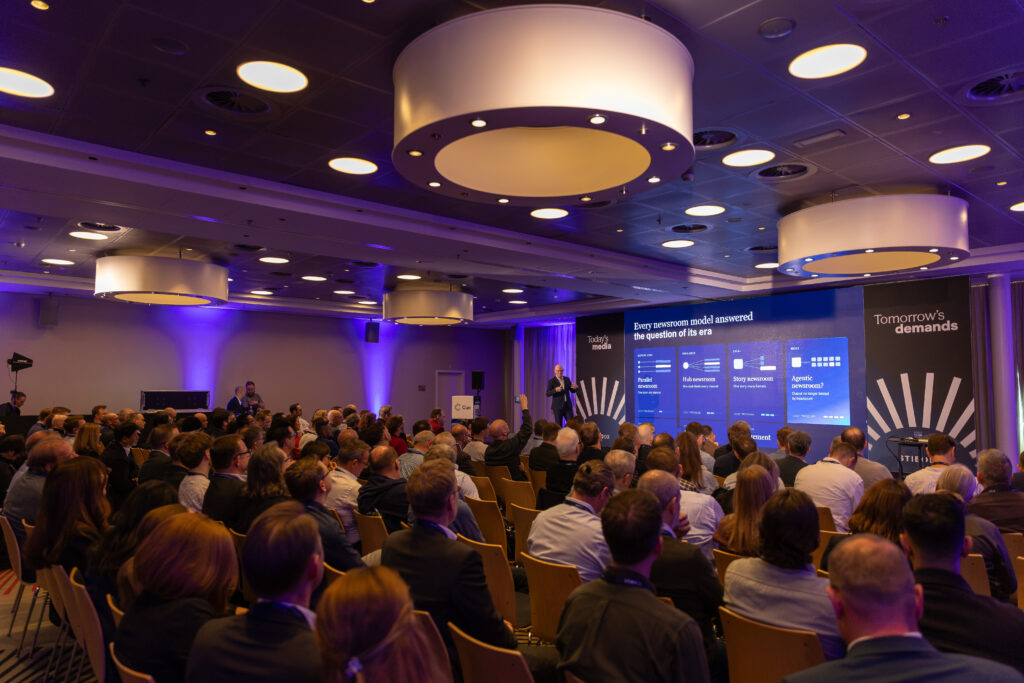
In his opening keynote, Lars Bjørn Falkenberg, CEO at Stibo DX, described a reimagined newsroom: one built around the story itself, where teams collaborate, formats are produced in parallel and trust is built in from the start.
For newsrooms, that means replacing fragmented tools with a governed, integrated platform that can handle growing complexity without adding more of it. AI, Lars warned, will multiply the wider cost of fragmentation. His conclusion was clear: the future of the newsroom is not more tools. It is consolidation.
2. The story guides planning and production
For many newsrooms, transformation starts by putting the story at the center of the workflow.
Masahide Naraoka, Head of Media X Design Lab, Shizuoka Shimbun, described an old workflow at the Japanese newspaper in which an article was considered finished only when the print page was locked. Staff then reformatted the same story by hand for digital the next morning. Today, Shizuoka Shimbun is moving towards a story-first approach: report once, publishing in many formats.
Francico Torres Vázquez, Executive VP, Organización Editorial Mexicana (OEM), shared a similar journey at group level. OEM is the largest Mexican print media company and the largest newspaper company in Latin America. By bringing 45+ news brands and verticals onto the Cue media enterprise platform, OEM has created a shared foundation for planning, content, assets and publishing, while allowing each newsroom to retain its own local editorial identity. The next step is to connect planning even more closely to production, so teams can see what is being covered, who is responsible and how each story will develop across the portfolio.
3. Video becomes part of the Cue platform
A story-first workflow only works if every format is part of it, but today, video production often sits outside the main editorial workflow. Footage, editing and publishing may happen in separate systems, with professional production dependent on specialist tools and hardware.
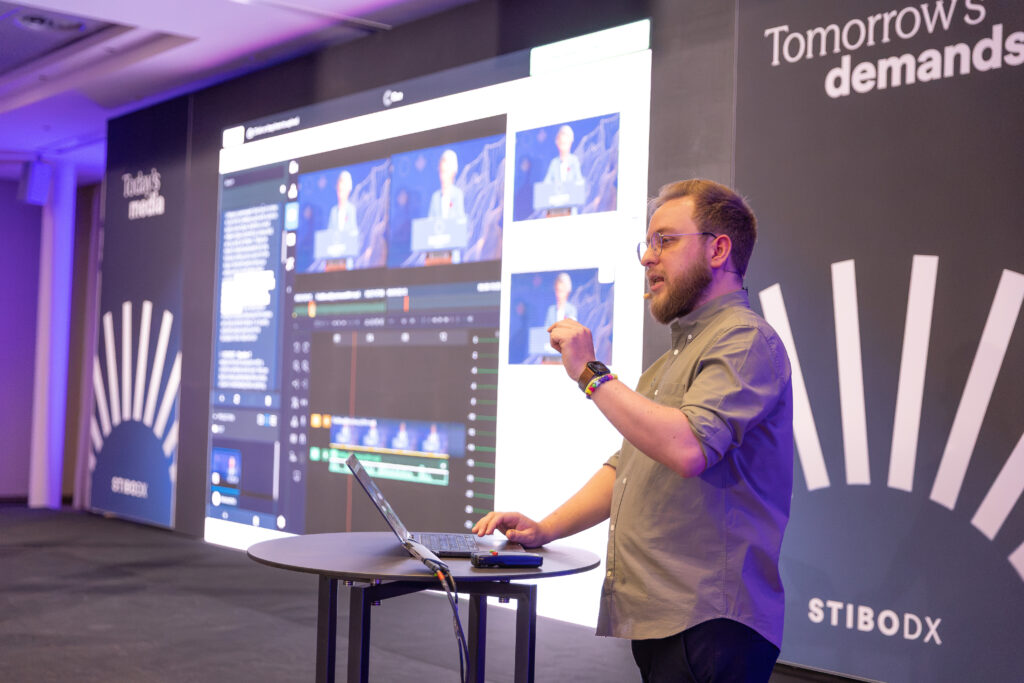
At Cue Days, Christian Loiborg, Senior Product Manager, Stibo DX, presented the new video capabilities coming to the Cue media enterprise platform. The direction is one connected workflow from footage to every channel, with browser-based, broadcast-grade editing embedded in the Cue platform. Text-based editing will give everyday contributors an accessible way to create straightforward video, while professional editors will retain timeline-based tools for more advanced production.
The point is not to add another video editor. It is to make video part of the same workflow as text, audio, graphics and print, from planning and production through to publishing. Stories are multimodal. The workflow should be too.
4. Complexity and fragmentation raise cost and limit growth
But every new format and channel can potentially multiply the work behind each story.
Six formats, seven channels, 10 audience segments and five AI assistants can add up to more than 2,100 variants of one story, each potentially needing to be created, checked, rights cleared, published and measured. Lars Bjørn Falkenberg introduced this illustrative calculation in his opening keynote to show how quickly complexity can grow.
Adding tools rarely reduces complexity.
Max Rempel, CEO, Frankfurter Rundschau, illustrated how quickly this complexity can grow. Two systems have one possible connection, 10 systems have 45, and 20 systems have 190. His point was that complexity does not grow linearly. More locations, configurations and exceptions can increase the work involved in testing, upgrades, training, support, monitoring and security.
Selma Stern, Independent Advisor to Media Executives, applied the same logic to organizational structure. Ten leaders create 45 possible relationships, while 10 systems create 45 possible connections. Each integration requires decisions on both sides and can introduce another layer of alignment. She called the resulting burden the Change Tax: the energy required to get work done in a structure that no longer fits the goals.
Every additional system may solve an immediate need, but it can also add integrations, duplicated effort and operational dependencies.
5. Consolidation on the Cue media enterprise platform lowers unit cost
But every new format and channel can potentially multiply the work behind each story.
Six formats, seven channels, 10 audience segments and five AI assistants can add up to more than 2,100 variants of one story, each potentially needing to be created, checked, rights cleared, published and measured. Lars Bjørn Falkenberg introduced this illustrative calculation in his opening keynote to show how quickly complexity can grow.
Adding tools rarely reduces complexity.
Max Rempel, CEO, Frankfurter Rundschau, illustrated how quickly this complexity can grow. Two systems have one possible connection, 10 systems have 45, and 20 systems have 190. His point was that complexity does not grow linearly. More locations, configurations and exceptions can increase the work involved in testing, upgrades, training, support, monitoring and security.
Selma Stern, Independent Advisor to Media Executives, applied the same logic to organizational structure. Ten leaders create 45 possible relationships, while 10 systems create 45 possible connections. Each integration requires decisions on both sides and can introduce another layer of alignment. She called the resulting burden the Change Tax: the energy required to get work done in a structure that no longer fits the goals.
Every additional system may solve an immediate need, but it can also add integrations, duplicated effort and operational dependencies.
6. Consolidation reduces what you run. SaaS changes who runs it.
As your platform becomes more capable, keeping it running and up to date becomes a bigger job.
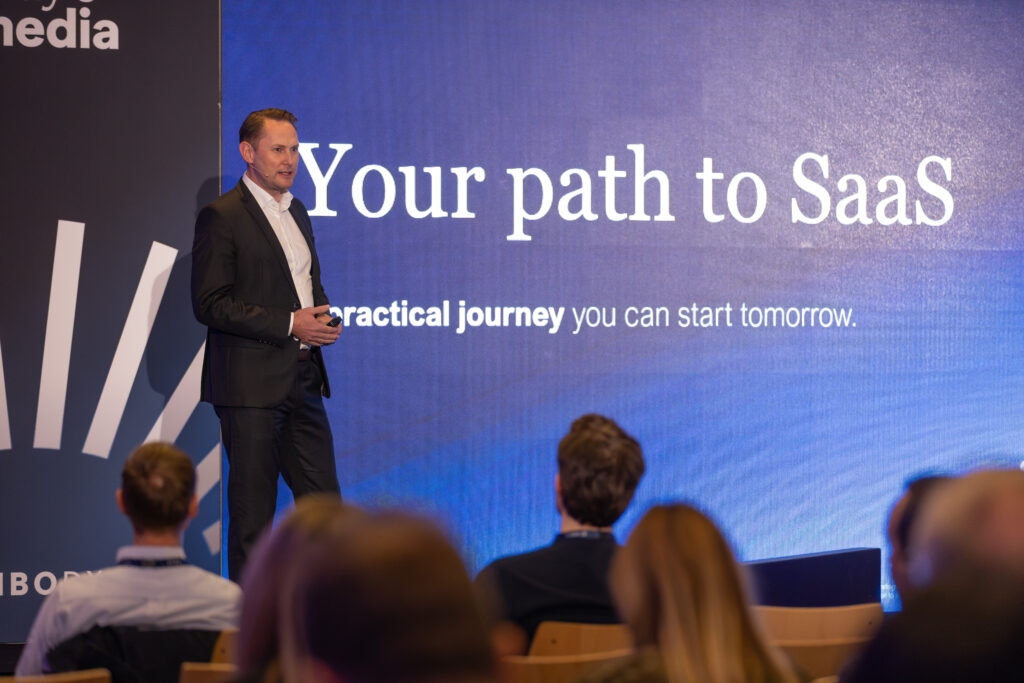
Morten Kvist Thomsen, Chief Services Officer, Stibo DX, explained that for customers, the value of SaaS is less time spent managing infrastructure, upgrades and platform maintenance, and more capacity to focus on newsroom development and business priorities.
Stibo DX takes broader responsibility for operating and evolving the platform through shared services, managed releases and continuous improvements. A common foundation also allows new capabilities and security updates to reach customers faster, without each organization having to plan and carry out its own upgrade project.
Learn more about your journey to SaaS with Stibo DX and register your interest.
7. AI belongs inside governed workflows
A shared platform, run as a service, provides the foundation for AI to become part of everyday newsroom workflows, applied where it can deliver practical value.
Tore G. C. Rich, Product Manager for Generative AI, JP/Politiken Media Group, traced the organization’s AI tools from proofreading and headline suggestions to an extension that brought the capabilities directly into the Cue platform.
“Value jumped when we got into the workflow,” Tore G. C. Rich said. Today, Cue Autopilot supports writers inside the article, while JP/Politiken Media Group is building shared AI capabilities, enablement and strategic governance so teams can innovate without losing control over security, data and quality.
As Francisco Torres Vázquez explained, OEM is taking a similar governed approach. Its editorial guidelines are being built into Cue Autopilot prompts, with editors reviewing AI-generated output.
Across both examples, AI assistance sits inside the editorial workflow, with editorial standards and human review retained.
8. People lead distinctive journalism, agents handle repeatable work
Once AI sits inside the workflow, the next question is how to divide the work between people and agents. At Cue Days, Mark van de Kamp, Chief Innovation and Chief Product Officer at Stibo DX, introduced Stibo DX’s Signature Newsroom, an operating model for using AI to expand a newsroom’s capacity without losing the journalism that makes it distinctive. The model separates work into two connected layers, helping news organizations decide where people should lead and where agents can support scale.
In the signature layer, people lead and agents assist. Original reporting, investigation, analysis, relationships and editorial judgment create distinctive value.
In the flow layer, agents can increasingly support repeatable production, including briefs, alerts and structured outputs from verified sources, while people retain oversight.
Both answer to the same standards and share the same foundation, including story intent, the editor’s brief to people and agents, as well as provenance, rights, and accountability.
9. The Cue platform evolves into an agentic platform
Dividing work between people and agents requires a platform built for both. Henrik Dudek Povlsen, Director, Innovation at Stibo DX, presented the evolution of the Cue platform into an agentic platform: people and agents working across planning, content creation and delivery within the same governed workflows.
Workflow Automation provides the orchestration layer, coordinating work across automation, AI and people while maintaining approval gates and an audit trail of each step.
MCP, or Model Context Protocol, provides a standard way for AI agents to connect to systems and take action. In the Cue platform, an MCP gateway gives authorized agents access only to approved capabilities, using existing permissions with no direct access to internal services, and a clear audit trail. You stay in control of what people and agents are allowed to do inside the Cue platform.
At the center is the story. Story Intent defines what is true, the angle and the limits, while the story record brings together verified elements, sources, provenance, rights and editorial decisions. Together, they connect planning, creation, automation and delivery: the story-first workflow in key takeaway #2, now shared by people and agents.
10. Technology alone cannot transform the newsroom
Platforms, AI and SaaS can change the tools of the newsroom, but transformation also depends on how the organization itself is structured. Selma Stern described the hidden organizational friction created when structures no longer fit the work. “We misdiagnose a structure problem as a culture problem,” she said.
This is the “change tax” introduced in takeaway #4: the energy required to get work done when roles, relationships and decision-making become increasingly difficult to navigate.
McClatchy showed what getting the structure right can look like in practice: standardize where it removes unnecessary complexity and leave room for what makes journalism distinctive.
Kerry Bean, Senior Vice President, Publishing & Partnerships at McClatchy Media Co., summarized the approach: “Standardize the system, not the creativity.”
At McClatchy, fonts, tags, shapes, page templates, page names, page grids, output options, output devices, content workflows and ad pagination were standardized. Photo selection, retouching, layout choices, collaboration and the ability to switch ads by geography or platform remained flexible. As Kerry Bean put it, the first group is the foundation that makes production work, while the second is the “craft” where creativity lives.
Where to start
Taken together, the 10 takeaways and the customer examples behind them show how the newsroom is evolving.
The story sits at the center. A modular, fully integrated platform reduces fragmentation. AI operates inside governed workflows. Agents take on more repeatable work. Journalists focus more of their time where human judgment, relationships and creativity matter most. And an organization built to fit the work makes all of it possible.
But none of this has to happen at once.
The first step is to define where your media business is going and let that direction shape the technology plan.
The Cue Discovery Program, shared at Cue Days, helps you turn your strategic ambitions into a clear, actionable path forward. Working with Stibo DX, you align business and technology priorities, identify the areas with the greatest potential for transformation, and define a vision tailored to your organization. The result is a grounded business case, cost overview and implementation plan that gives you a stronger foundation for deciding what to prioritize, where to invest and how to move forward.
Get in touch about the Cue Discovery Program
Sources
-
[1] Reuters Institute for the Study of Journalism (2026). Digital News Report 2026. University of Oxford. Reuters Institute
-
[2] Zylo (2025). 2025 SaaS Management Index. Zylo
-
[3] MuleSoft (2025). 2025 Connectivity Benchmark Report.